Consecutive Interior Angles Converse Definition
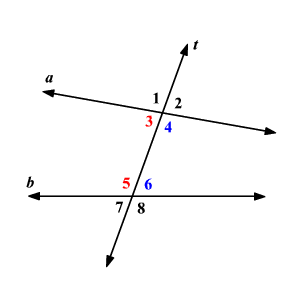
Consecutive Interior Angles Theorem
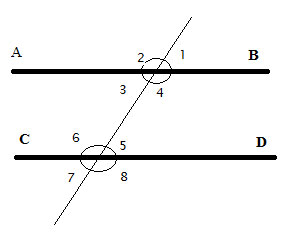
Consecutive Interior Angles Converse Theorem Geometry Help
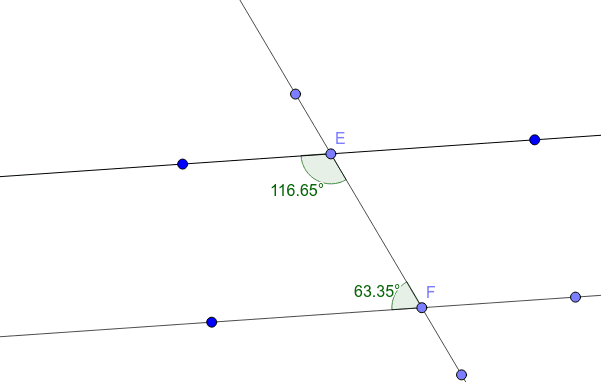
Converse Of Same Side Consecutive Interior Angles Theorem Geogebra
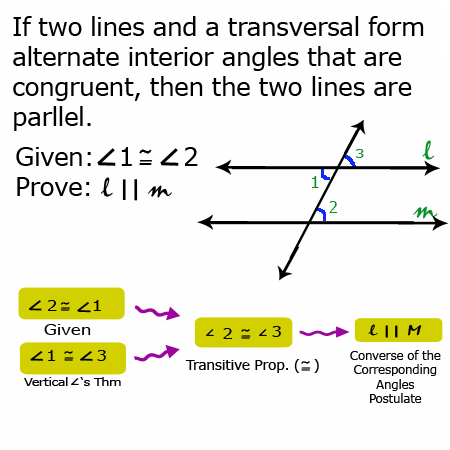
Converse Of The Alternate Interior Angles Thm Algebra And Geometry Help

Proof Alternate Exterior Angles Converse Youtube
Prove Line And Angle Theorems With Video Lessons Worksheets Games Activities
When two lines are crossed by another line which is called the transversal the pairs of angles.
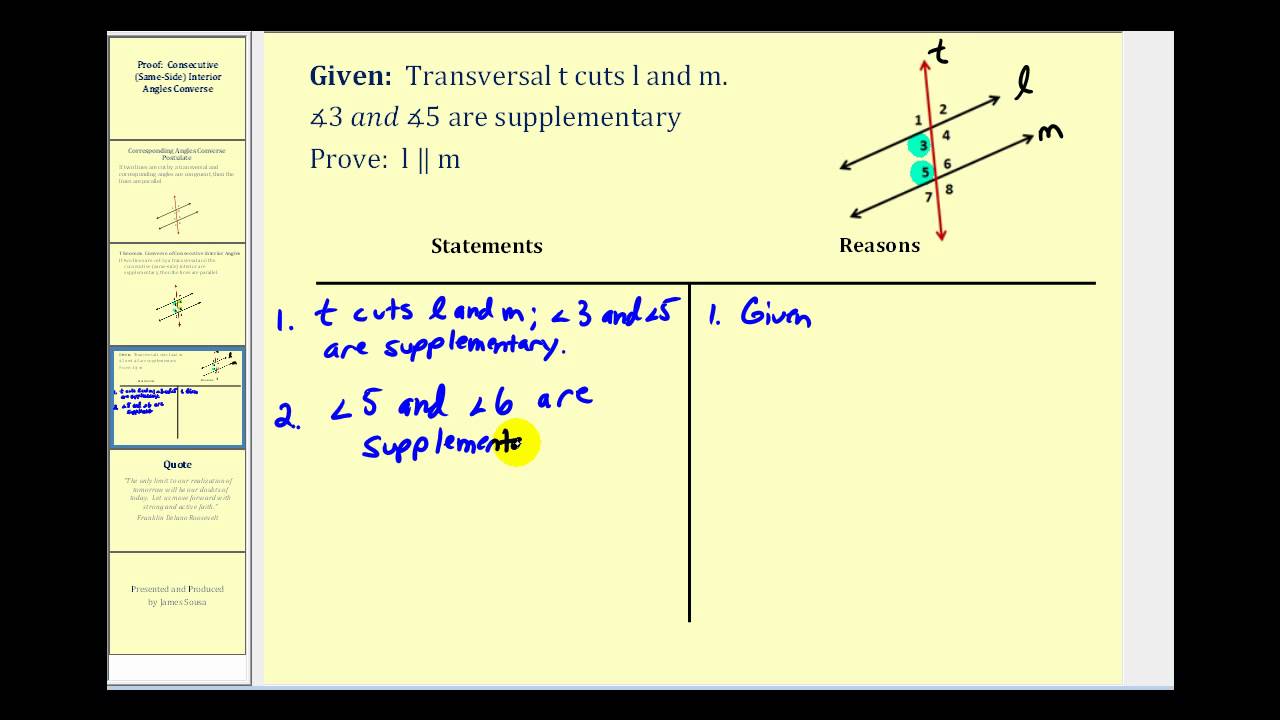
Consecutive interior angles converse definition. This theorem states that if two lines are cut by a transversal so that the consecutive interior angles are supplementary then the lines are said to be parallel. The theorem states that if the two lines are parallel then the consecutive interior angles are supplementary to each other. Are called consecutive interior angles.
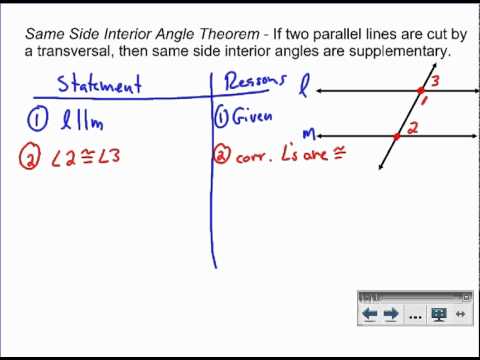
Consecutive interior angles theorem. On one side of the transversal. Consecutive interior angles are the pairs of angles that are between two lines and on the same side of the line cutting through the two lines.
The consecutive interior angles converse is used to prove that two lines crossed by a transversal are parallel. This is the converse because you are given two lines and have to prove that they are parallel the consecutive interior angles converse states that if two lines are cut by a transversal so that consecutive interior angles are supplementary then the lines are parallel. Also the angles 4 and 6 are consecutive interior angles.
Therefore ab is parallel to cd. The angle pairs are consecutive they follow each other and they are on the interior of the two crossed lines. This lesson will demonstrate how to prove lines parallel with the converse of the consecutive interior angles theorem.
The consecutive interior angles theorem states that when the two lines are parallel then the consecutive interior angles are supplementary to each other. Consecutive interior angles when two lines are cut by a transversal the pair of angles on one side of the transversal and inside the two lines are called the consecutive interior angles. C d c f d f since d and f are alternate angle and are equal.
But inside the two lines. C d 180. In the figure the angles 3 and 5 are consecutive interior angles.
Same Side Interior Angles Proof Youtube

Pin On Back To 4th Grade

Proving Lines Parallel Proof Activity High School Geometry Proofs Geometry Proofs High School Activities Geometry High School

Parallel Lines Inb Pages Teaching Geometry Math Interactive Notebook 8th Grade Math

Pin On Education
